
What STC measures
Sound Transmission Class is a single number that describes how well a wall, door, floor, or ceiling blocks airborne sound. It is measured by playing sound on one side of an assembly and measuring how much comes through on the other side across a range of frequencies, then fitting the results to a standard curve. A higher number means less sound gets through.
A typical interior office wall, one layer of gypsum board on each side of metal studs with no insulation, lands somewhere around STC 35 to 40. You can hear a conversation through it and often make out words. Add insulation and a second layer of gypsum and the number climbs. Secure facilities start where ordinary construction stops.
What the Tech Spec requires
The IC Tech Spec does not list STC numbers directly for each room. It assigns a sound group to the space based on what happens inside it, and each sound group corresponds to a minimum STC rating for the perimeter.
Sound Group 3, STC 45 or better. Loud speech inside the facility can be faintly heard outside but not understood. Normal speech is unintelligible to a listener outside. This is the baseline for most secure spaces.
Sound Group 4, STC 50 or better. Very loud sounds inside, the Tech Spec uses the examples of loud singing, brass music, or a radio at full volume, can be heard faintly or not at all outside. This is required where the activity inside the space, or the environment around it, calls for more protection: conference rooms where discussions will be loud, spaces adjacent to areas that are not controlled, or where the accrediting authority decides the threat warrants it.
The sound group is assigned during concept approval by the accrediting authority. It is not the builder's call, and it is not something to negotiate later.
Why the whole assembly has to earn the rating
This is the part that catches people. STC is a property of a complete assembly, not of a wall type on a drawing. A wall built to an STC 50 design will test well below STC 50 if anything in it leaks sound. And a secure perimeter is full of things that can leak.
The wall itself. The Tech Spec wall types use three layers of 5/8-inch gypsum board over 16-gauge metal studs with 3.5 inches of sound attenuation material in the cavity for Sound Group 3, and add a fourth layer of gypsum on the uncontrolled side for Sound Group 4. Joints are staggered so there is no straight path through the layers. The insulation has to be fastened so it cannot slump and leave a void at the top.
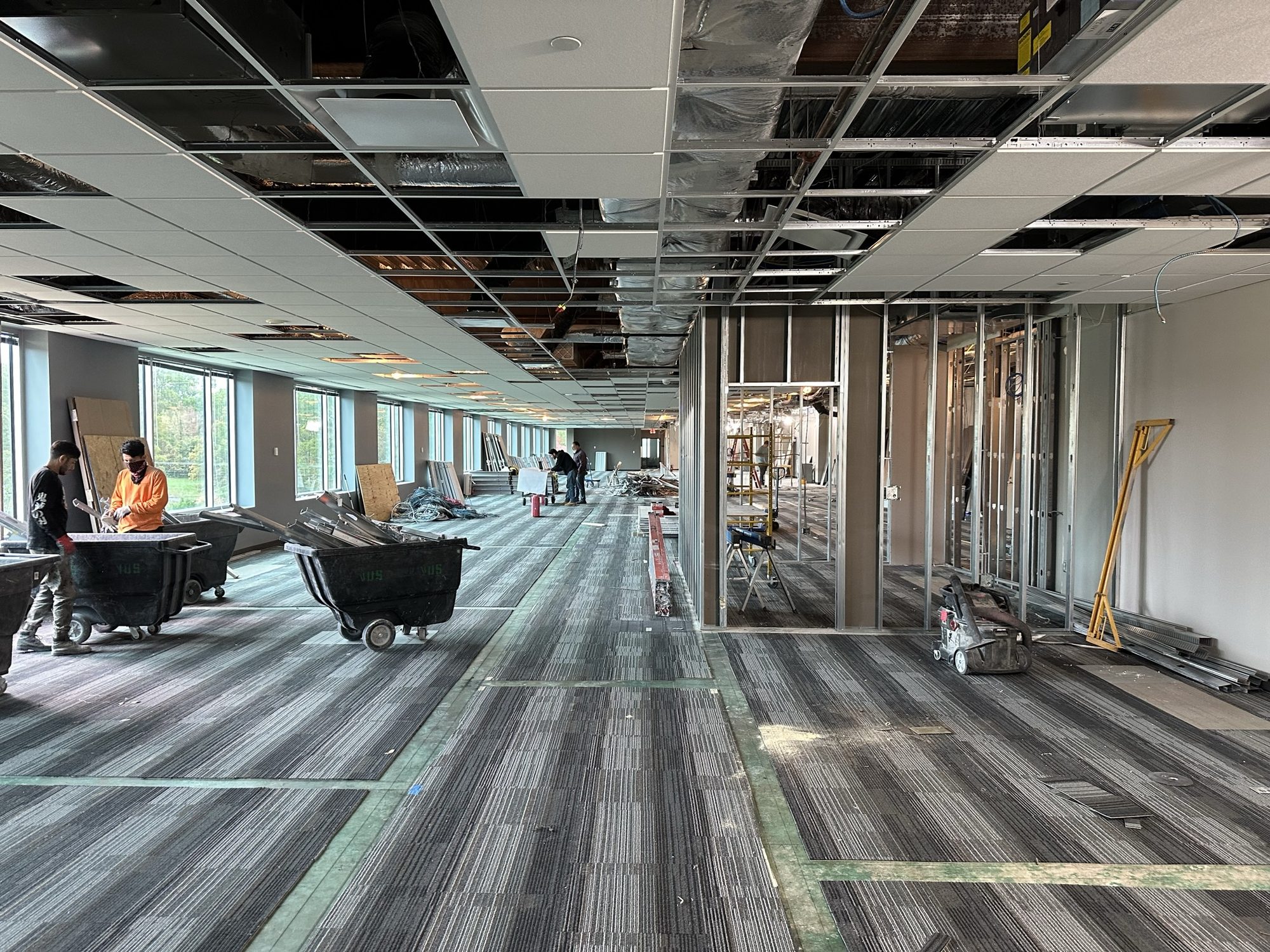
The top and bottom. The wall runs from the structural floor to the structural ceiling, and both joints are sealed with acoustic sealant or non-shrink grout on both sides. A wall that stops at a dropped ceiling has an STC rating of roughly zero above the grid, no matter how well the visible part is built.
Doors. The door is usually the weakest point. A standard hollow metal door is far below STC 45. Secure doors are rated assemblies: a solid or acoustic core leaf, a sealed frame, perimeter seals, and an automatic door bottom that drops when the door closes. Every gap around a door is a path for sound.
Ducts. Air has to move, and sound travels with it. Duct penetrations through the perimeter need acoustic treatment: lined duct, sound baffles, or a Z-shaped path that forces sound to turn corners. The Tech Spec also requires that the opening around the duct be fully sealed.
Penetrations. Every conduit, pipe, and cable pass-through is sealed. A single unsealed one-inch sleeve can drop a wall's measured rating by several points.
Outlets and boxes. Back-to-back electrical boxes in a rated wall are a classic leak. Boxes are offset, surface-mounted, or run in raceways on furred walls so the gypsum layers stay continuous.
Testing and what happens when it fails
Acceptance testing measures the actual assembly in place. A sound source is placed inside, a meter outside, and the result either meets the sound group or it does not. If a perimeter fails, the first job is finding the leak, which usually means opening ceilings and checking seals. That is why the inspection-before-concealment habit matters so much: a leak found while the wall is open is a ten-minute fix. The same leak found at acceptance testing can take days.
Sound isolation is not sound masking
One more distinction worth knowing. STC is about sound isolation: stopping sound from passing through the perimeter. Sound masking is a different tool: adding controlled background noise outside the perimeter so that any sound that does get through is harder to understand. Some facilities use both. Masking does not substitute for a perimeter that meets its STC rating, and the accrediting authority will not accept it as one. We cover masking in a separate article.
Planning a secure facility in Maryland, Virginia, or Washington, DC? Envision Solutions builds SCIF and SAPF perimeters as complete assemblies and tests them before the accrediting official does. Request a quote or call 301-247-7229.
Written by

Envision Solutions
Envision Solutions is a design-build general contractor based in Newburg, Maryland, serving Maryland, Virginia, and Washington, DC. The team builds ICD-705 SCIF and SAPF facilities with cleared personnel and veteran-led preconstruction, and self-performs framing, drywall, and finishes on secure work. Founded in 2013. Articles are written at an unclassified level and reviewed by the Envision preconstruction team.